
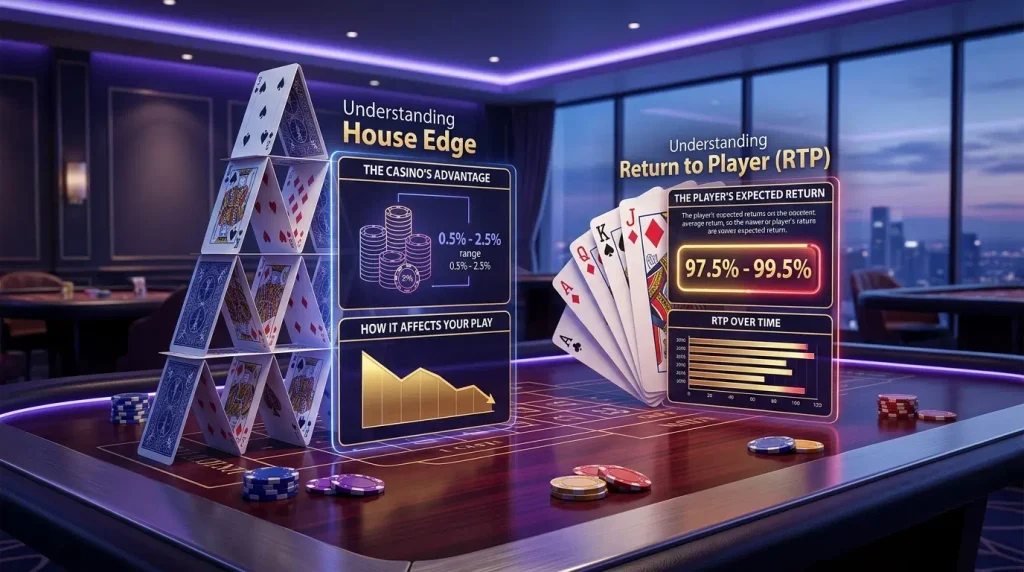
You’ll hear these two terms constantly the moment you start paying real attention to how casino games work: house edge and RTP. People toss them around like they mean the same thing, and honestly, that mix-up causes more confusion than it clears up. At Panalobet Casino Plus, we’d rather you actually get what these numbers are telling you instead of just nodding along because everyone else seems to understand them. So let’s actually walk through both, using the card games most people already play.
House Edge, In Plain Terms
House edge is just the casino’s built-in mathematical advantage over players, measured across the long haul. It shows up as a percentage, and roughly speaking, it tells you how much of every dollar wagered the house expects to hold onto once you zoom way out over thousands of hands. Say the edge is 2% — that means for every $100 bet over time, the house statistically keeps around $2. That’s not saying you’ll lose exactly two bucks tonight on a $100 bankroll. Short sessions swing all over the place. It’s a long-run average, nothing more, nothing less.
What RTP Is Really Saying
RTP, short for Return to Player, is house edge looked at from the other side. A game sitting at 98% RTP has a 2% house edge — same math, just flipped. RTP tells you what slice of all the money wagered on a game eventually finds its way back to players. Higher RTP, generally speaking, means friendlier odds, which is exactly why it’s worth a glance before you settle into any game for a while. One catch though — RTP gets crunched over millions of rounds, not the handful you’re about to play, so think of it as a broad expectation, not a promise for tonight.
Blackjack: A Game Where You Can Actually Move the Needle
Blackjack has one of the tightest house edges out there, often dropping under 1% for anyone using solid basic strategy. What sets it apart from most other card games is that your choices genuinely matter — knowing when to hit, stand, double, or split cuts the house’s edge noticeably compared to playing off pure instinct. Play carelessly, though, and that edge climbs in a hurry. Get the strategy down, and blackjack becomes one of the friendlier panalobet games on the floor for anyone willing to actually learn it.
Baccarat: Straightforward, With Numbers That Don’t Budge
Baccarat is refreshingly simple since there’s really no in-game decision-making beyond which bet you place. Banker bets typically land around a 1.06% edge, player bets sit slightly higher near 1.24%, and the tie bet jumps well past 14% — a big payout on paper, but usually one to steer clear of. Because there’s no strategy layer during actual play, the odds stay fixed regardless of how much experience you bring to the table. Your only real choice is which bet to make in the first place.
Poker Variants: A Bit of a Different Animal
Poker doesn’t quite fit the same mold, since in games played against other players rather than the house, there isn’t really a traditional house edge — casinos typically take a rake instead. But casino-banked poker games like Casino Hold’em or Three Card Poker do carry a house edge, and it varies quite a bit by game, usually falling somewhere between 2% and 5% depending on the rules and any side bets in play. Those side bets specifically tend to run a much steeper edge than the main game, so it’s worth checking the actual numbers before piling extra chips onto them.
Why This Should Actually Guide What You Play
Once these two ideas click, picking a game stops being guesswork and turns into something more deliberate. A player sticking to lower-edge games and playing them properly is simply going to come out ahead of someone hopping between high-edge bets without ever checking the math. This matters a lot when you’re browsing table games casino online, where a huge stack of variants sit side by side and the gap in edge between them can be bigger than people expect. Comparing house edge numbers across a few table games casino online picks before you commit is a small habit that quietly pays for itself.
Turning This Into Something Useful
Putting all this to work is easy in practice — before jumping into any card game, spend a minute checking its house edge or RTP, especially while browsing table games casino online, where that info is usually sitting right next to the game itself. Lean toward the lower-edge options when you have a choice, learn basic strategy for the games that reward it, and stay a little skeptical of side bets unless you’ve actually looked at their numbers.
Final Thoughts
House edge and RTP aren’t just figures for people who love spreadsheets — they’re genuinely useful tools that affect how much value you get out of every session. Games look a lot more alike on the surface than they actually are, and knowing what’s underneath turns casino play into something you approach with real awareness instead of blind guessing. At Casino Plus, we’d rather see players making informed calls over random ones, and these two ideas are about as good a starting point as it gets.